Heather Donnelly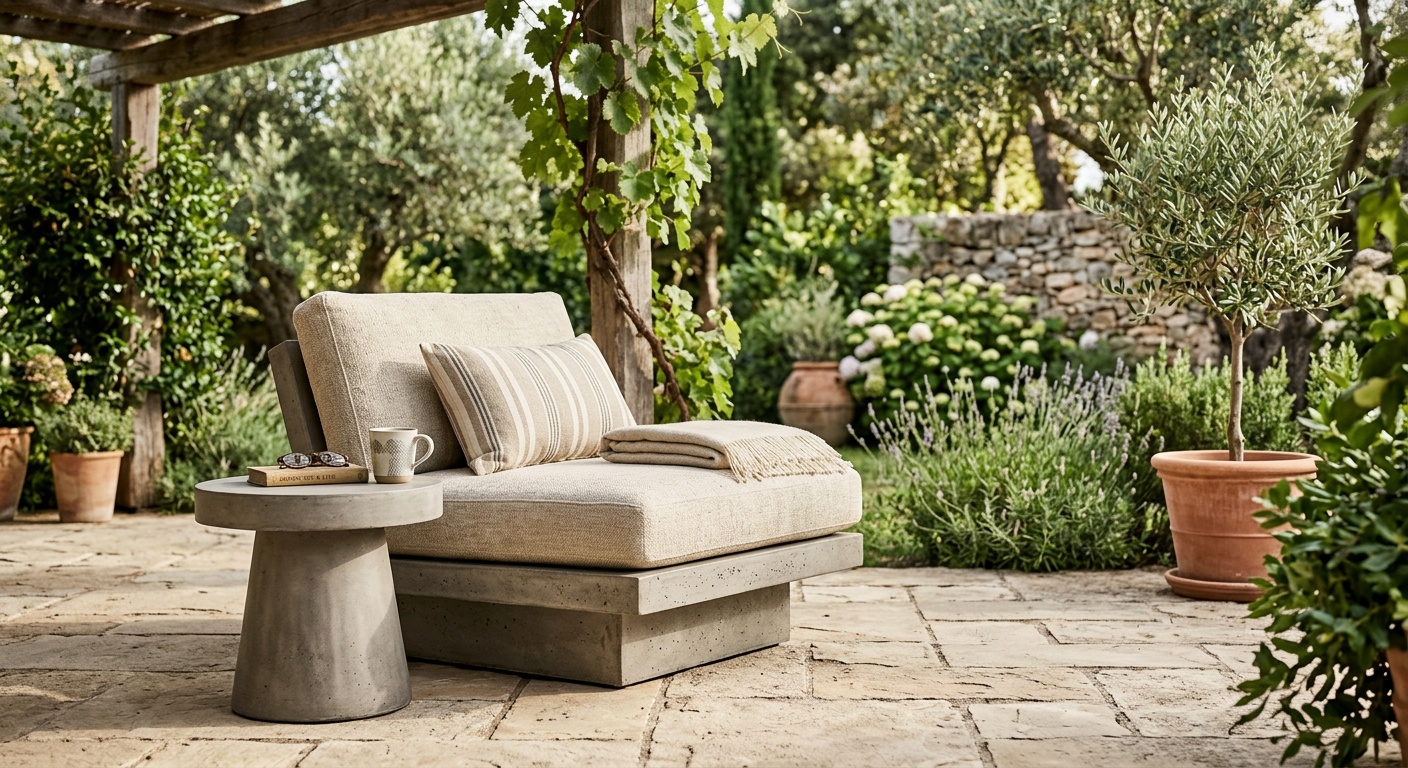
Small Concrete Patio Ideas That Maximize Outdoor Living Space
Reading time: 12 minutes
Ever stared at a tiny backyard slab and thought, “What on earth can I actually do with this?” You’re in good company. Millions of homeowners across North America are working with compact outdoor footprints — and in 2026, the demand for smart, stylish small concrete patios has never been stronger. According to the American Society of Landscape Architects, outdoor living improvements remain among the top three home renovation priorities for the fourth consecutive year, with over 73% of homeowners citing patios and hardscaping as their primary focus.
Here’s the straight talk: a small concrete patio isn’t a limitation — it’s a design challenge worth embracing. With the right layout, finishes, and furnishing strategies, even a 100-square-foot slab can feel like an intentional outdoor sanctuary. Let’s break down exactly how to make that happen.
Table of Contents
- Why Concrete Is the Smart Choice for Small Patios
- Layout Strategies That Create the Illusion of Space
- Decorative Finishes That Transform Plain Slabs
- Creating Functional Zones in a Compact Area
- Furniture and Accessory Choices That Work Hard
- Common Challenges and How to Overcome Them
- Data Snapshot: What Homeowners Are Choosing in 2026
- Frequently Asked Questions
- Your Outdoor Living Transformation: Next Steps
Why Concrete Is the Smart Choice for Small Patios
When you’re working with limited square footage, every material decision matters. Concrete consistently outperforms alternatives like pavers, wood decking, and gravel in terms of versatility, longevity, and cost-effectiveness — especially in compact spaces where precision is everything.
The Cost-to-Value Case for Concrete
In 2026, the average cost to install a basic poured concrete patio runs between $6 and $12 per square foot, compared to $15–$25 per square foot for natural stone pavers. For a 150-square-foot patio, that’s a potential savings of $1,350 to $1,950 — money you can redirect toward landscaping, lighting, or premium outdoor furniture.
But raw cost isn’t the only story. Concrete’s adaptability means it can mimic the look of stone, wood grain, brick, and tile through stamping, staining, and engraving techniques. You’re not locked into an industrial gray slab. You’re starting with a blank canvas.
Durability matters too. Properly poured and sealed concrete patios can last 25–30 years with minimal maintenance. A 2025 study published by the Portland Cement Association confirmed that stamped concrete surfaces maintained structural integrity significantly longer than composite decking in both freeze-thaw and high-humidity environments.
Environmental Considerations in 2026
Sustainability is now a key decision factor for homeowners. Modern concrete mixes increasingly incorporate fly ash and recycled aggregate materials, reducing the carbon footprint by up to 30% compared to traditional Portland cement formulations. Several major contractors now offer low-carbon concrete options as a standard choice, not an expensive upgrade. If eco-consciousness matters to you, ask your contractor specifically about supplementary cementitious materials (SCMs) when requesting quotes.
Layout Strategies That Create the Illusion of Space
Here’s a design truth that experienced landscape architects swear by: how you orient and frame a small patio matters more than its actual dimensions. The following strategies work with the psychology of perception to make compact spaces feel larger and more livable.
Diagonal Lines and Pattern Direction
One of the most powerful — and underused — tricks in small patio design is angling your concrete pattern diagonally. Whether you’re using stamped brick patterns, scored lines, or exposed aggregate sections, orienting them at 45 degrees to the longest wall of your house draws the eye outward and creates a sense of expanded depth.
Quick Scenario: Imagine you have a 10×12-foot patio directly off your kitchen door. Laid straight, the pattern emphasizes the boxy shape. Rotated 45 degrees, those same lines guide the eye toward the corners, making the space feel more like a diamond than a rectangle — and perceived depth increases noticeably. This is a standard technique used by landscape designers working in urban townhouse settings.
Borders and Framing Elements
Adding a contrasting border — either through a different concrete color, a stamped edge detail, or an inlaid band of exposed aggregate — gives your small patio a “picture frame” effect. This visual containment trick is borrowed from interior design: a framed rug makes a room feel more intentional and larger. The same principle applies outdoors.
Practical tip: Use a 6-inch border in a complementary tone rather than a starkly contrasting one. High contrast can emphasize smallness; subtle contrast creates sophistication and depth without shrinking the perceived space.
Extending Into the Landscape
One of the most effective layout strategies for small patios is blurring the boundary between the concrete surface and the surrounding landscape. Stepping stones that extend outward from the main slab, a concrete walkway that curves away toward a garden bed, or decorative gravel edging that feathers into planting zones all give the eye a natural continuation path — making the patio feel like part of something larger.
Case Study — The Morrison Residence, Austin TX (2025): A landscape design firm worked with a family on a 120-square-foot rear concrete patio. By extending three concrete stepping pads in an organic arc toward a small raised garden bed, the effective “outdoor living perception zone” expanded by roughly 40%, even though no additional concrete was poured. The project won a regional Landscape Industry Award for small-space design in 2025.
Decorative Finishes That Transform Plain Slabs
This is where small concrete patios genuinely shine. The finishing possibilities available in 2026 are extraordinary — and many are accessible to ambitious DIYers, not just professional contractors.
Stamped Concrete
Stamped concrete uses textured molds pressed into freshly poured concrete to replicate patterns like flagstone, cobblestone, slate, or even wood planks. The cost premium over plain concrete is typically $5–$12 per square foot, but the visual impact is transformative. For small patios, large-format stone patterns (like 18×18 flagstone) tend to work better than busy, small-scale patterns, which can make a compact space feel cluttered.
Acid Staining and Water-Based Staining
Staining is ideal for existing slabs you want to refresh without demolition. Acid staining chemically reacts with the concrete to produce rich, variegated earth tones — browns, terracottas, greens, and blues — with a marble-like depth. Water-based stains offer a broader color palette and are more predictable in application. Either approach costs $2–$6 per square foot professionally applied, or significantly less for skilled DIY application.
Exposed Aggregate
Exposed aggregate finishes reveal the natural stone, pebble, or recycled glass mixed into the concrete. This finish adds tactile texture, visual interest, and natural slip resistance — a practical benefit in outdoor settings. In 2026, crushed recycled glass aggregate in sea green and amber tones has become particularly popular in coastal and Pacific Northwest markets.
Concrete Overlays and Microtoppings
If your existing slab is in reasonable structural condition but looks tired, a concrete overlay (1/8 to 1/4 inch thick) can completely transform the surface. Modern polymer-modified overlays bond exceptionally well and can be stamped, stained, or textured just like fresh concrete. This is the budget-conscious renovation win of 2026 — contractors are reporting a 35% increase in overlay requests compared to 2024, driven by homeowners avoiding full demolition costs.
Creating Functional Zones in a Compact Area
The single biggest mistake people make with small patios is treating them as one undifferentiated space. Even a 100-square-foot concrete slab can support two or three distinct functional zones if you’re intentional about it.
Think of it like studio apartment design applied outdoors: a kitchen, a living area, and a workspace all coexist in 500 square feet because of smart zoning, not magic square footage.
The Dining Zone
Position your dining area as close to your kitchen or back door as possible to minimize the distance food travels. A 4-person bistro-style table requires only about 36–40 square feet including chair pullout space. Consider a fold-down wall-mounted table if your patio is against a fence or house wall — when not in use, it folds flat, freeing the space entirely.
The Lounge Zone
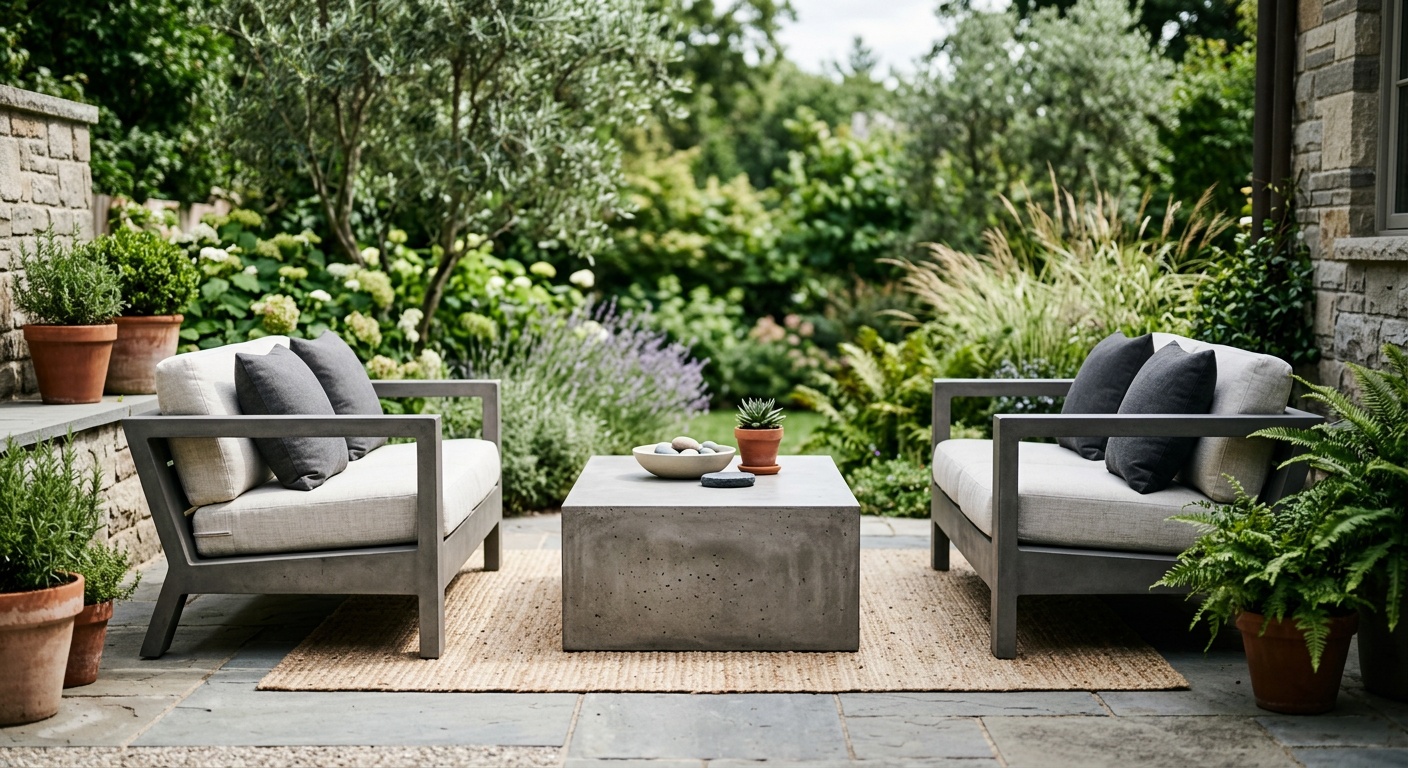
Low-profile seating — such as concrete benches with cushions built into the patio perimeter, or floor-level lounge chairs — keeps the sightlines open while creating a relaxed social area. Built-in concrete bench seating along one or two edges of your patio eliminates the need for freestanding furniture that consumes valuable floor space.
The Planting Zone
Incorporating planters directly into or adjacent to your concrete patio adds color, privacy, and a sense of enclosure that makes small spaces feel more intimate. Raised concrete planters poured as integral extensions of the main slab are both structurally sound and visually cohesive. In urban environments, a single 24-inch raised planter with ornamental grasses or bamboo can create meaningful privacy screening from neighboring properties.
Furniture and Accessory Choices That Work Hard
On a small concrete patio, every piece of furniture needs to earn its place. The guiding principle: flexibility, scale, and multi-functionality.
Oversized furniture is the most common sabotage move in small patio design. A 7-foot sectional sofa that would look stunning on a 400-square-foot deck becomes a claustrophobic obstacle course on a 120-square-foot patio. Scale down and double up on function instead.
High-performing furniture choices for small concrete patios:
- Stackable chairs — store vertically when not in use, deploy for entertaining
- Ottoman-storage combos — provide seating, footrests, and weatherproof cushion storage
- Drop-leaf dining tables — seat two daily, expand to seat six for gatherings
- Wall-mounted folding bars — serve as a drink station and disappear when not needed
- Vertical plant stands — add greenery without consuming floor real estate
- Compact fire pits — tabletop propane models provide ambiance without the footprint of traditional fire rings
Lighting is often an afterthought, but it’s transformative. String lights draped above a small concrete patio effectively double the perceived ceiling height and extend usability into the evening. In 2026, solar-powered Edison string lights have reached performance parity with plug-in models — fully charged in 6–8 hours of sunlight, running for 8–10 hours of warm illumination.
Common Challenges and How to Overcome Them
Let’s address the real friction points that trip up small patio projects — and how to navigate each one with confidence.
Challenge 1: Drainage and Water Pooling
Concrete is impervious, which is great for durability but problematic if your slab traps water. Poor drainage leads to standing puddles, algae growth, and eventual surface damage. The solution requires attention at the planning stage, not the finishing stage.
Pro approach: Ensure your concrete is poured with a minimum 1/8-inch-per-foot slope away from your house foundation. For existing slabs with drainage issues, a concrete overlay can be feathered to correct grade. Alternatively, consider integrating a narrow channel drain along one edge of the patio, which can be surfaced with a decorative grate to remain aesthetically unobtrusive.
Challenge 2: Heat Retention in Hot Climates
Dark, plain concrete can absorb significant solar heat in summer — making barefoot walking uncomfortable and elevating ambient temperatures. This is increasingly relevant as 2026 summer temperatures continue trending above historical averages across much of the U.S. Southwest and South.
Smart solutions: Choose lighter concrete colors or reflective aggregate finishes. Light gray, cream, and buff tones reflect significantly more solar radiation than charcoal or dark brown. A shade structure — pergola, sail shade, or retractable awning — reduces surface temperature by 10–20°F. For existing slabs, a light-toned reflective coating or overlay is a highly effective retrofit.
Challenge 3: Privacy in Tight Urban Settings
Many small patios exist in dense urban or suburban environments where neighbors are close and sightlines are unwelcome. Privacy enhancers that work without consuming patio floor space include vertical trellises with climbing plants, tall integrated concrete planters with ornamental screening plants, bamboo fence panels, and lattice screens mounted to existing fence lines. The key is going vertical — it’s the unused dimension that small patio owners consistently overlook.
Data Snapshot: What Homeowners Are Choosing in 2026
Based on 2025–2026 industry surveys from the National Concrete Masonry Association and Houzz’s Annual Home Design Report, here’s what’s trending in small concrete patio projects right now.
Most Popular Small Patio Concrete Finishes (2026)
Source: National Concrete Masonry Association / Houzz Design Trends Report 2026
Comparative Table: Small Patio Material Options
| Material | Cost/sq ft | Lifespan | Maintenance | Design Versatility |
|---|---|---|---|---|
| Poured Concrete | $6–$12 | 25–30 yrs | Low | ⭐⭐⭐⭐⭐ |
| Natural Stone Pavers | $15–$25 | 30–50 yrs | Medium | ⭐⭐⭐⭐ |
| Composite Decking | $12–$22 | 15–25 yrs | Medium | ⭐⭐⭐ |
| Gravel/Decomposed Granite | $1–$4 | 5–10 yrs | High | ⭐⭐ |
| Concrete Pavers | $8–$18 | 20–30 yrs | Low–Medium | ⭐⭐⭐⭐ |
Frequently Asked Questions
How small is too small for a concrete patio, and what’s the minimum useful size?
The practical minimum for a truly functional concrete patio is around 64 square feet (8×8 feet). At this size, you can comfortably fit a small bistro table with two chairs and have room to move around them. Anything smaller starts functioning more like a landing pad than a living space. That said, an 8×8 slab can still be beautifully finished and feel intentional with the right furniture scale and surrounding landscape context. If your available footprint is under 64 square feet, consider whether a combination of concrete stepping stones and gravel could create a more functional layout than a single small slab.
Can I pour a small concrete patio myself, and when should I hire a professional?
A DIY pour is genuinely achievable for a simple, ground-level slab under 200 square feet — provided you’re comfortable with physical work and careful about preparation. The critical steps — proper subbase compaction, correct concrete mix, adequate slope for drainage, and timely finishing — can each be learned from reliable sources. However, hire a professional when your project involves: significant grade changes or retaining elements, proximity to tree roots that require expert navigation, decorative stamping or complex staining you want guaranteed, or any structural integration with your home’s foundation. The cost of fixing a poorly poured slab far exceeds the savings of DIY in those scenarios.
What’s the best way to heat or cool a small concrete patio for year-round use?
For year-round usability, the most effective approach is layering solutions rather than relying on a single fix. In cooler months, a propane or natural gas patio heater (or wall-mounted infrared heater for covered patios) combined with a retractable awning or clear vinyl curtain panels dramatically extends the season. In hot climates, shade sails or pergola structures reduce surface temperature, while a misting fan system can drop the perceived temperature by 15–20°F. In 2026, electric infrared heaters with smart home integration have become a popular upgrade — they’re efficient, controllable by voice or app, and safe for covered concrete patio environments.
Your Outdoor Living Transformation: Next Steps
Here’s the truth about small concrete patios in 2026: size is the least interesting thing about them. What matters is intention — and you now have the framework to approach your project strategically rather than reactively.
As urban density increases and homes are built with smaller lot sizes across North America, the ability to transform compact outdoor spaces into genuine living areas will only become more valuable — both for personal quality of life and for property resale appeal. Your small concrete patio isn’t a compromise. It’s an opportunity to design something genuinely intentional.
Your action-oriented roadmap:
- Measure and map your space this week. Know your exact square footage, identify drainage direction, and note sun exposure patterns throughout the day. This informs every decision that follows.
- Choose your finish first, then plan your furniture. Finish determines the aesthetic language of the space. Once you’ve committed to a direction — stamped flagstone, acid-stained earth tones, or polished aggregate — your furniture and accessory choices become much easier.
- Get three contractor quotes, and ask each one specifically about low-carbon concrete options. In 2026, sustainable mix alternatives are readily available and competitively priced — but contractors won’t always volunteer the option without being asked.
- Design your zones on paper before buying a single piece of furniture. Sketch your dining zone, lounge zone, and planting zone with rough dimensions. It takes 20 minutes and prevents expensive mistakes.
- Plan for lighting from day one. Electrical or solar? String lights, step lights, or path lighting? These decisions are easiest when the slab is being poured, not after the fact.
The broader shift in how we use our homes — toward hybrid work, neighborhood socializing, and intentional outdoor wellness — makes every square foot of your outdoor space more meaningful than it was five years ago. Your concrete patio, however modest in size, is part of that story.
So here’s the question worth sitting with: If you could use your small outdoor space the way you actually want to live — morning coffee, evening conversations, weekend cooking, quiet reading — what would it need to look like? Start there. Build backward. The concrete is just the foundation.