Heather Donnelly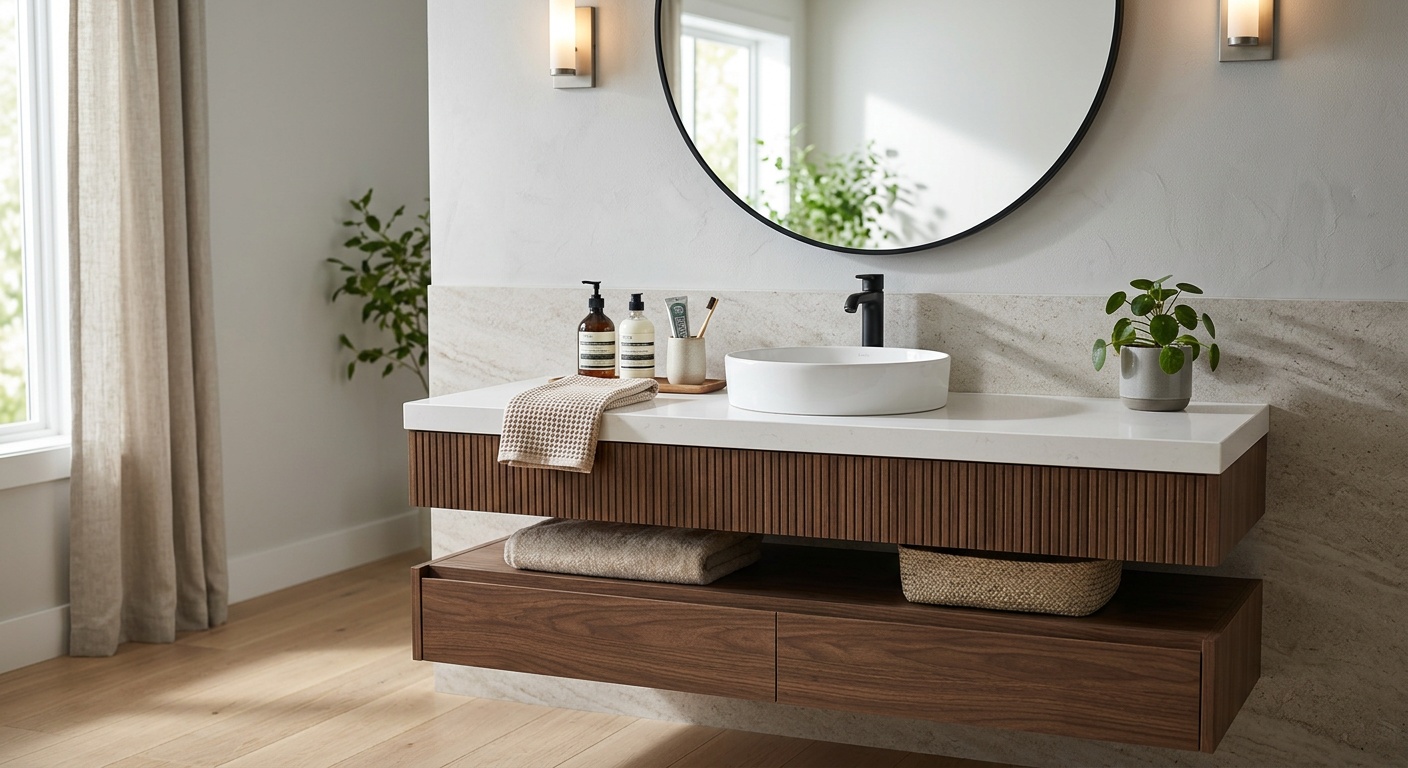
Bathroom Interior Design Ideas to Modernize Your Home Affordably
Reading time: 12 minutes
Let’s be honest — the bathroom is probably the most underestimated room in your home. You spend time in it every single morning, every evening, and yet it’s usually the last space people think to renovate. Sound familiar? Here’s the thing: a modernized bathroom doesn’t just elevate your daily experience — it can boost your home’s resale value by up to 10–15% according to a 2025 National Association of Realtors report. And you don’t have to spend a fortune to get there.
Whether you’re working with a compact apartment bathroom or a sprawling ensuite in need of a refresh, this guide walks you through the smartest, most cost-effective design strategies for 2026. From trending aesthetics to budget hacks that actually work, we’ve got the full roadmap.
Table of Contents
- Why Modernizing Your Bathroom Matters in 2026
- Top Bathroom Design Trends Dominating 2026
- Affordable Modernization Strategies That Actually Work
- DIY vs. Professional: Making the Right Call
- Real-World Case Studies: Before and After
- Bathroom Upgrade Options: Cost vs. Impact
- Popular Bathroom Upgrades: Homeowner Satisfaction Rates
- Common Challenges and How to Overcome Them
- FAQs
- Your Bathroom Transformation Roadmap: Next Steps
Why Modernizing Your Bathroom Matters in 2026
The interior design landscape shifted dramatically post-pandemic, and bathrooms emerged as one of the biggest beneficiaries of that shift. As people spent more time at home, the demand for spa-like, functional, and aesthetically pleasing bathrooms skyrocketed. By 2026, this trend has only deepened.
According to the 2025 Houzz Bathroom Trends Study, 67% of homeowners who renovated their bathrooms reported a significant improvement in their daily mood and morning routines. That’s not just anecdotal — it reflects how deeply our environments affect our wellbeing.
Beyond personal satisfaction, bathroom renovations deliver strong financial returns. A mid-range bathroom remodel averages a 60–70% return on investment at resale, making it one of the most financially strategic home improvements you can make. And in 2026’s competitive housing market, updated bathrooms are increasingly a deciding factor for buyers.
Quick Scenario: Imagine you’re hosting guests for a week. Where does the awkward silence hit hardest? The bathroom. A dated, dingy space creates an impression you can’t undo. But with strategic upgrades — even on a tight budget — you can transform that narrative entirely.
Top Bathroom Design Trends Dominating 2026
Design trends in 2026 aren’t about following the crowd — they’re about blending personal expression with functional innovation. Here’s what’s actually driving the conversation:
Biophilic Design: Bringing Nature Indoors
Biophilic design — the philosophy of connecting interior spaces with the natural world — has moved from niche to mainstream. In bathrooms specifically, this translates to:
- Living plant walls or mounted greenery shelves near natural light sources
- Natural stone finishes like travertine, slate, and limestone on floors and accent walls
- Warm wood tones in vanities, shelving, and even (moisture-resistant) wall panels
- Earthy color palettes: terracotta, warm beige, sage green, and warm whites
Interior designer Mara Hendricks, based in Austin, Texas, told Architectural Digest in early 2026: “Clients want their bathrooms to feel like a retreat, not a utility room. Biophilic elements are the fastest way to achieve that transformation without a full overhaul.”
Smart Bathroom Technology: Function Meets Luxury
Smart home technology has fully entered the bathroom space. In 2026, the most sought-after tech upgrades include:
- Smart mirrors with integrated LED lighting, anti-fog technology, and built-in displays for weather or news
- Heated flooring systems with app-controlled thermostats
- Touchless faucets that reduce water waste by up to 30% (EPA estimates)
- Voice-activated shower systems that pre-set temperature preferences
The good news? Smart bathroom tech has become significantly more affordable. Entry-level smart mirrors now start at around $150–$250, and touchless faucets can be installed for under $100 in a simple DIY project.
Minimalist and Japandi Aesthetics
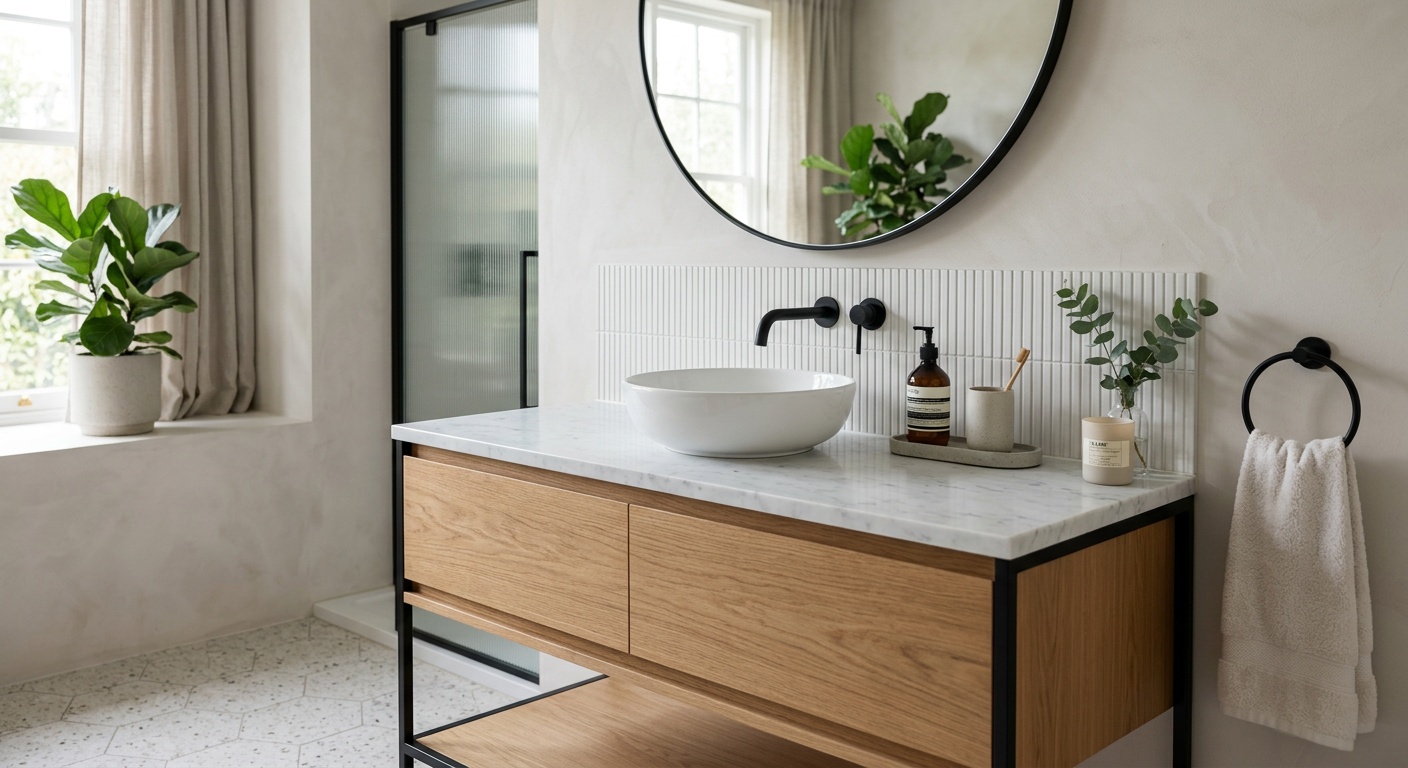
The Japandi movement — a fusion of Japanese minimalism and Scandinavian hygge — continues its strong run in 2026. Key characteristics include:
- Clean lines with zero visual clutter
- Floating vanities that create an illusion of more floor space
- Matte black or brushed gold fixtures
- Neutral, muted color schemes with one bold accent element
This style is particularly powerful for smaller bathrooms because its principles of intentional simplicity make compact spaces feel curated rather than cramped.
Bold Tilework as a Design Statement
Gone are the days when tiles were purely functional. In 2026, homeowners are using tiles as art. Think:
- Zellige tiles (handmade Moroccan ceramic tiles) for textured, artisanal appeal
- Large-format tiles (60x120cm or larger) to reduce grout lines and create a seamless, expansive look
- Patterned floor tiles in geometric or floral prints as a focal point in otherwise neutral bathrooms
Affordable Modernization Strategies That Actually Work
Here’s the straight talk: you don’t need a $30,000 renovation to modernize your bathroom. Some of the most impactful changes cost less than $500 — it’s about knowing where to invest strategically.
High-Impact, Low-Cost Upgrades
1. Repaint and Refresh
A fresh coat of moisture-resistant paint is the single highest-ROI bathroom upgrade. The average cost? $50–$200 for a standard bathroom. Choose colors intentionally — deep navy creates drama, sage green promotes calm, and warm white opens the space.
2. Replace Hardware and Fixtures
Swapping out outdated chrome faucets, towel bars, cabinet handles, and light fixtures for modern matte black or brushed brass equivalents costs between $100–$400 total and creates an immediate visual transformation. This is the designer secret that most budget renovation guides overlook.
3. Regrout and Reseal Existing Tiles
Before ripping out dated tiles, consider regrouting them. Fresh grout can make a tiled surface look brand new. Cost: $50–$150 DIY. If the tiles themselves are a poor color, there are now high-quality tile paints that bond directly to ceramic surfaces.
4. Upgrade Lighting
Bathroom lighting is massively underrated. Replacing a single outdated overhead light with a layered lighting approach — vanity lights, ambient ceiling fixtures, and perhaps a dimmer — costs $150–$600 and completely changes the atmosphere of the room.
5. Invest in a Statement Mirror
A well-chosen mirror does double duty: it reflects light to make the space feel larger and acts as a design anchor. Arched mirrors, backlit LED mirrors, and oversized rectangular mirrors are all trending in 2026. Budget: $80–$350.
6. Refresh Your Vanity Without Replacing It
Painting a vanity cabinet and replacing the hardware and countertop (consider budget-friendly quartz remnants or butcher block alternatives) can make an old vanity look bespoke for under $200.
Pro Tip: Focus your budget on the elements that carry the most visual weight — mirrors, lighting, and hardware. These three categories create a disproportionate design impact relative to their cost.
DIY vs. Professional: Making the Right Call
One of the biggest mistakes homeowners make is either DIY-ing everything (including complex plumbing) or hiring professionals for tasks they could easily manage themselves. Here’s a practical decision framework:
Do it yourself (confidently):
- Painting walls, ceiling, and vanity cabinets
- Replacing faucets, showerheads, and towel bars
- Installing a new mirror
- Swapping out light fixtures (if comfortable with basic electrical)
- Regrouting tiles
- Installing peel-and-stick flooring tiles
Hire a professional for:
- Moving or adding plumbing lines
- Installing a new shower enclosure or bathtub
- Tile installation on large surfaces (experience prevents costly mistakes)
- Electrical work beyond basic fixture swaps
- Waterproofing and wet area membranes
The rule of thumb: if a mistake could cause water damage or structural issues, invest in professional expertise. If a mistake is purely cosmetic and reversible, try it yourself.
Real-World Case Studies: Before and After
Case Study 1: The $800 Apartment Bathroom Refresh
Jessica and Tom, a couple renting out a two-bedroom apartment in Chicago, needed to modernize a tired bathroom in their rental property before a new tenant arrived. With an $800 budget and a single weekend, they achieved the following:
- Painted walls in Benjamin Moore’s Chantilly Lace (warm white) — $65
- Installed a brushed gold faucet and matching towel bar set — $185
- Replaced the old vanity light with a three-bulb matte black bar fixture — $120
- Added an arched frameless mirror — $140
- Regrouted floor tiles — $60 in materials
- Added open wood shelving for storage and decor — $95
- New shower curtain, bath mat, and accessories — $85
Total spent: $750. The result? Their rental listing photos generated 40% more inquiries than the previous year, and they secured a tenant within four days of listing — at a higher monthly rent.
Case Study 2: The $4,500 Mid-Range Master Bathroom Overhaul
Priya, a homeowner in Portland, Oregon, tackled her master bathroom with a modest but purposeful budget. Her goals were to modernize a 1990s-era bathroom without moving any walls or plumbing. Here’s how she allocated her budget:
- New floating vanity with integrated sink — $800
- Large-format floor tiles (DIY installation) — $600
- Frameless shower glass panel to replace shower curtain — $900
- Subway tile accent wall behind vanity — $300 materials + $400 labor
- Smart LED mirror with anti-fog — $220
- New brushed nickel fixtures set — $280
- Repainted ceiling and trim — $90
- Miscellaneous (caulking, grout, accessories) — $150
Total: $3,740. Her home was appraised six months later, and the bathroom renovation contributed to an estimated $8,000 increase in home value — more than double her investment.
Bathroom Upgrade Options: Cost vs. Impact
| Upgrade Type | Average Cost (2026) | Visual Impact | ROI at Resale | DIY Friendly? |
|---|---|---|---|---|
| Paint & Hardware Swap | $100–$400 | ⭐⭐⭐⭐ | High | ✅ Yes |
| New Vanity + Mirror | $600–$1,500 | ⭐⭐⭐⭐⭐ | High | ⚠️ Partial |
| Tile Replacement | $1,200–$4,000 | ⭐⭐⭐⭐⭐ | Medium–High | ❌ Professional Recommended |
| Smart Tech (Mirror, Faucets) | $250–$800 | ⭐⭐⭐ | Medium | ✅ Yes |
| Full Bathroom Renovation | $8,000–$25,000 | ⭐⭐⭐⭐⭐ | 60–70% ROI | ❌ Professional Required |
Popular Bathroom Upgrades: Homeowner Satisfaction Rates (2026)
Based on a 2025–2026 survey of 1,400 homeowners who completed bathroom renovations, here’s how different upgrade categories ranked in terms of satisfaction:
94%
88%
85%
79%
72%
Source: HomeAdvisor 2025–2026 Homeowner Renovation Satisfaction Report
Common Challenges and How to Overcome Them
Challenge 1: Working With a Tiny Bathroom
Small bathrooms are arguably the most common renovation challenge in urban homes and apartments. The trap most people fall into? Trying to make the bathroom feel “bigger” by cramming in too many design elements. The solution is counterintuitive: embrace the smallness with intentional design.
Practical strategies for small bathrooms:
- Use large-format floor tiles to reduce visual grout lines and create a sense of continuity
- Install a wall-mounted toilet to free up several inches of floor space
- Opt for a pedestal sink or floating vanity to expose more floor area visually
- Use vertical storage — tall, narrow shelving pulls the eye upward
- Install a clear glass shower enclosure instead of curtains to prevent visual interruption
- Choose a monochromatic color scheme to create visual flow without breaks
Challenge 2: Navigating a Limited Budget
Budget constraints are universal. The key to overcoming them is prioritization sequencing — deciding which upgrades have the largest visual impact per dollar spent, and tackling those first.
The priority sequence for maximum impact on a limited budget:
- Paint (highest ROI per dollar)
- Lighting (transforms atmosphere immediately)
- Mirror (design anchor and light amplifier)
- Hardware and fixtures (details that make the whole room feel cohesive)
- Textiles (towels, bath mat, shower curtain — the finishing layer)
If you follow this sequence and run out of budget, you’ll still have a dramatically improved bathroom. Start with tiles and vanities only if the foundation (paint, light, mirror, hardware) is already solid.
Challenge 3: Outdated Tile That’s Expensive to Replace
Dated tile is one of the most common bathroom complaints, and full replacement is expensive and disruptive. Here are three solutions that don’t require demolition:
- Tile paint: High-quality tile paint formulas (like Rust-Oleum’s Tub & Tile Refinishing Kit) bond directly to ceramic and porcelain. Results last 3–5 years with proper care.
- Tile overlays: Thin peel-and-stick tile overlays (popular from brands like Aspect and WallFace) can transform floors and walls without removing existing tile.
- Strategic cover-up: Use a bold tile accent wall on one side of the bathroom to draw attention away from the dated tiles on the remaining walls.
Frequently Asked Questions
How much does a mid-range bathroom renovation cost in 2026?
In 2026, a mid-range bathroom renovation — which typically includes a new vanity, updated fixtures, fresh tile, and lighting upgrades without moving plumbing — runs between $8,000 and $15,000 in most U.S. markets. Costs vary significantly by region, with urban markets like New York, San Francisco, and Chicago running 20–40% higher. If you’re tackling cosmetic upgrades only (paint, hardware, mirror, lighting), you can achieve impressive results for $500–$2,000.
What’s the single most impactful low-cost bathroom upgrade?
Lighting is consistently rated as the highest-impact low-cost upgrade by both interior designers and homeowners. Replacing a single outdated bathroom light with a properly positioned, warm-toned vanity bar light can make the space look completely different — and influence everything from how your skin looks in the mirror to the perceived size and cleanliness of the room. Budget as little as $80–$200 for a quality fixture that makes a visible difference immediately.
Are smart bathroom technologies worth the investment in 2026?
For most homeowners, yes — particularly touchless faucets, smart mirrors, and programmable heated floors. Touchless faucets reduce water consumption by 20–30%, which translates to measurable annual savings on water bills. Smart mirrors add functional value (integrated lighting, anti-fog, display features) that buyers increasingly expect. However, full smart shower systems with voice control tend to have higher installation costs and are better suited to premium renovations where luxury is a stated goal.
Your Bathroom Transformation Roadmap: Next Steps
Modernizing your bathroom doesn’t have to be overwhelming, expensive, or disruptive. With the right priorities and a clear action plan, you can create a space that feels genuinely current — one that improves your daily experience and strengthens your home’s value.
Here’s your practical roadmap to get started:
- Define your goal and budget first. Are you renovating to sell, to improve daily comfort, or to update rental property appeal? Your goal shapes your budget allocation entirely. Decide this before looking at a single tile sample or fixture catalog.
- Audit your bathroom’s biggest visual problems. Stand in the doorway and identify the top three elements that feel most dated or unappealing. Start your upgrade list there, not from a trend article.
- Prioritize the paint-light-mirror trifecta. If budget is tight, these three upgrades alone will modernize any bathroom. Do them together — the synergy between fresh color, improved lighting, and a statement mirror is greater than any one element alone.
- Source smart. In 2026, platforms like Wayfair, IKEA, and Amazon Basics offer stylish vanities, mirrors, and fixtures at price points that would have required high-end showrooms five years ago. Don’t pay showroom prices for items you can source online with equivalent quality.
- Think in phases if needed. You don’t have to do everything at once. Phase 1: cosmetic upgrades. Phase 2: fixtures and vanity. Phase 3: tile and structural elements. Phased renovations spread costs intelligently and allow you to evaluate results at each stage.
As we move deeper into 2026, the intersection of sustainability, smart technology, and design accessibility is reshaping what’s possible in home renovation — especially in bathrooms. The gap between “budget” and “luxury” aesthetic results continues to narrow, and informed homeowners who understand this are creating remarkable spaces without overspending.
Here’s the question worth sitting with: What does your ideal bathroom feel like to walk into every morning — and what’s the single first step you could take this weekend to move toward that vision? Start there. The transformation begins with one deliberate, well-chosen upgrade.